
The Cold War of Canvas: How Politics Shaped the Art World
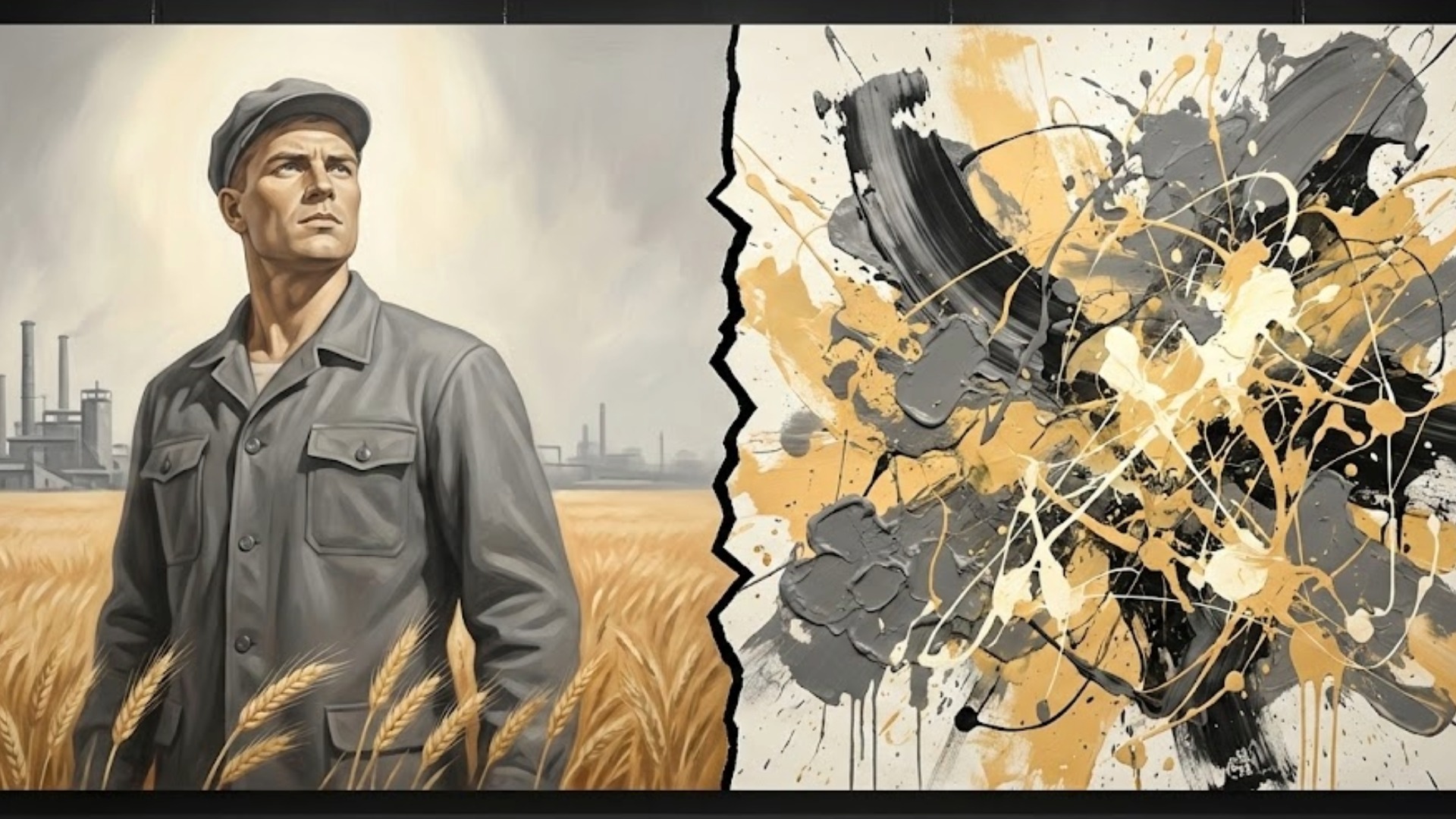
When we first began our journey into the heart of the Russian art world, we were on a simple quest for beauty and a desire to recover a lost artistic tradition. However, as we navigated the "cloak and dagger" reality of building our collection, we quickly realized that the history of these paintings was inseparable from the history of the Cold War itself.
We often think of the Cold War as a battle of ideologies fought with nuclear threats and spies. But there was another battlefield, one fought quietly in studios and galleries: the battle for your eyes. As we curate works that bridge the gap to this "lost" artistic world, it is fascinating to uncover how two powerful empires—the US and the USSR—used art as a weapon to control how the world thought.
Key Takeaways
- Art as a Weapon: The Cold War was fought with paintings as much as with politics.
- The Predictable vs. The Surprising: We expect the Soviet Union to control art, but the CIA's secret involvement in American art is the real shock.
- Double Irony: The CIA promoted abstract art to fight the Soviets, but the Soviets had actually championed similar abstract art (the Avant-Garde) just a generation earlier.
- The CIA's Strategy: The US government secretly funded abstract art to prove American freedom, using a strategy called the "Long Leash."
The Battle for Your Eyes
The 20th century was a massive battlefield of ideas. While soldiers stood ready with guns, a different war was fought with paintbrushes. On one side, the Soviet Union used art for propaganda. On the other side, the United States pushed for art that looked wild and chaotic.
At first glance, this looks like a simple fight between government control and total liberty. But the truth is more complicated. This is a story of two powerful empires. Both wanted to control how the world thought, but they used very different methods. One used the iron fist of the state, while the other used the hidden hand of spies.
The Predictable Propaganda vs. The Secret Plot
It surprises no one that the Soviet Union used art for propaganda. We are all familiar with the images of muscle-bound factory workers, smiling farmers, and golden wheat fields. This was "Socialist Realism". The state demanded art that was clear, optimistic, and supportive of the Communist Party. If an artist didn't follow the rules, they were silenced. This was the "iron fist"—obvious, heavy-handed, and expected from a totalitarian regime.
But here is the twist that we often discuss with our collectors: the "free world" was doing the same thing, just in the shadows. While the Soviets openly commanded their artists, the United States government quietly manipulated theirs. The real shock of the Cold War art battle isn't that the Soviets controlled culture, but that the Central Intelligence Agency (CIA) did, too. The spy agency saw American art not just as culture, but as a weapon to prove that the US was the land of the free.
We actually experienced the lingering paranoia of this era firsthand. The sheer volume of our acquisitions—over 4,000 paintings brought out of Russia—was so immense that we landed on the radar of the authorities. It went so far that, at one point, the CIA actually thought we were up to a secret plot! It turns out, the CIA knew a lot about secret art plots because they had invented one of the biggest ones in history.
The CIA’s Secret Weapon: Abstract Expressionism
To fight the Soviet image, the CIA needed an art style that looked like the exact opposite of rigid communist order. They found it in New York City. A group of artists known as Abstract Expressionists were making art that looked like explosions of color and energy.
The CIA loved this art because it didn't seem to have any political message. Artists like Jackson Pollock and Mark Rothko made paintings that were messy, personal, and unique. Even though many of these artists actually disliked the U.S. government, the CIA realized their art was perfect propaganda. It showed the world that America was a place where you could do whatever you wanted. It was the ultimate symbol of freedom.
The Ultimate Irony: The Soviet Avant-Garde
The story gets even stranger when you look at history. The CIA promoted Abstract Expressionism as a purely American invention that proved how "backward" the Soviets were. But in reality, the Soviet Union had invented a very similar style just a few decades earlier. Before Stalin took over, Russian artists led the world in abstract art. This movement was called the Avant-Garde.
Artists like Kazimir Malevich painted simple shapes, like his famous "Black Square", believing this new art was the true face of the revolution. In the 1910s and 20s, the Soviets were the cool, experimental ones. But when Stalin came to power, he crushed the Avant-Garde because he couldn't control it. So, the CIA was secretly funding a style of art to fight communism, even though that exact style was originally the "art of the revolution" in Russia. The US was essentially fighting the Soviets with the Soviets' own discarded weapon.
Comparing the Systems: Control vs. Influence
The Cold War was a battle of patronage (who pays the bills). Both the US and the USSR wanted to win, but they played the game differently. The Soviets used direct control to ensure loyalty, while the Americans used a "Long Leash" to project freedom.
| Feature | The Soviet System | The American (CIA) System |
|---|---|---|
| Who paid? | The State (Ministry of Culture) | Front organizations (CIA secret funds) |
| The Goal | Indoctrination and loyalty | Prove American cultural superiority |
| The Method | Direct orders and fear | Secret funding and influence |
| Artist Awareness | Artists knew they worked for the state | Artists often had no idea the CIA was involved |
To execute their plan, the CIA set up a group called the Congress for Cultural Freedom (CCF). This group operated in 35 countries. Their job was to nudge European thinkers away from Communism and toward the "American way". They secretly funded magazines and art shows. The Museum of Modern Art (MoMA) in New York became a key partner. While the Soviets built artists from scratch to serve the state, the CIA simply picked existing artists whose work happened to serve a geopolitical purpose—without telling them.
MoMA

The Human Cost and Legacy
The artists were the ones caught in the middle. In Russia, painters lived in a box. They had job security and money, but they had no freedom. In America, the artists lived in a bubble of irony. They thought they were rebels fighting against "the Man". They didn't know "the Man" was secretly paying for their gallery shows to win a political war.
In the end, the CIA's secret came out in the late 1960s. The scandal destroyed the Congress for Cultural Freedom. However, the legacy remains. The Americans created a belief that "real" art shouldn't be political. This idea still affects museums and galleries today, separating serious art from real-world problems.
Our mission at Lazare Gallery is to curate museum-quality art that captures the human condition, regardless of the politics that surrounded it. When we look at these works today, we see beyond the propaganda battles; we see the enduring spirit of the artists who created beauty in a divided world.
Frequently Asked Questions
Q: Did the CIA really pay artists directly?
Q: Why did Stalin ban the Avant-Garde if it started in Russia?
Q: Why is Soviet propaganda not considered surprising?
Would you like to explore the masterworks that survived this era?
View our collection of Russian Realism